An AI-Native Architecture for Autonomous Security Operations

SIRP 6.0.3 - Actually Autonomous

A Founder’s Technical Perspective

Faiz Shuja, Founder, Sirp

SIRP 6.0.3 - Actually Autonomous

Founder’s Preface

I have spent the better part of my career designing, operating, and scaling Security Operations Centers across different regions, regulatory environments, and threat landscapes. Over time, a pattern emerged that could not be ignored: most SOC failures were not caused by a lack of tools or talent, but by the structural limitations of the operating model itself.

Executive Summary

Security Operations Centers were designed for a world in which threats were episodic, alerts were manageable, and human analysts could remain the primary decision-makers. That world no longer exists.

This paper presents an AI-native security architecture that reframes the SOC as a governed decision pipeline—one that continuously senses, reasons, acts, and learns within explicit human-defined boundaries.

This architecture enables what is often described as a self-driving SOC — supervised autonomy, not uncontrolled automation.

1. The Structural Limits of the Traditional SOC

The fundamental constraint in modern security operations is not detection accuracy or tooling coverage. It is decision throughput.

Alert volume has exceeded human cognitive capacity. As volume increases, analysts compensate by simplifying decisions, relying on heuristics, or deferring action entirely. This introduces variance, which itself becomes a security risk.

2. Why Automation and SOAR Reach a Ceiling

SOAR platforms automate execution but preserve static decision logic. Playbooks encode known responses for known conditions. In environments defined by novelty and adaptation, this model fails structurally.

3. Principles of an AI-Native Security Architecture

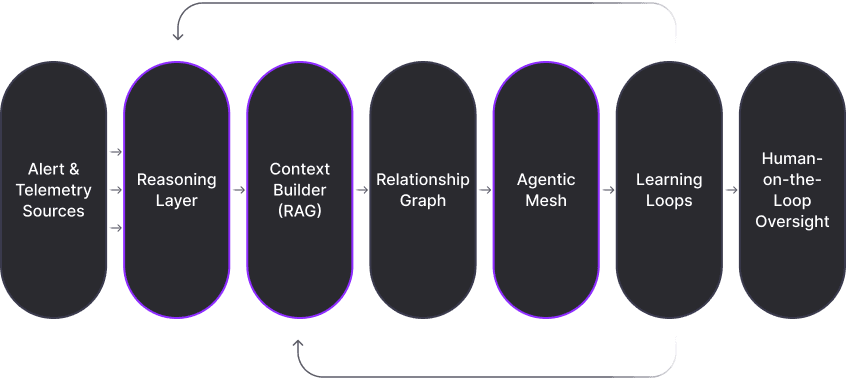
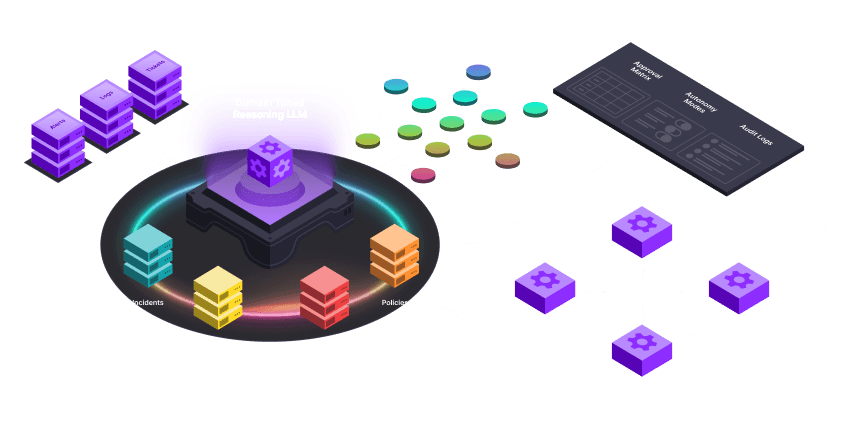
Designing an AI-native SOC requires starting from first principles rather than retrofitting intelligence onto legacy constructs. Decisions must operate at machine speed, context must be continuous, memory must be explicit, learning must be embedded, autonomy must be bounded, and systems must degrade gracefully.

Diagram: AI-Native SOC Core Architecture

Executive Summary

Security Operations Centers were designed for a world in which threats were episodic, alerts were manageable, and human analysts could remain the primary decision-makers. That world no longer exists.

This paper presents an AI-native security architecture that reframes the SOC as a governed decision pipeline—one that continuously senses, reasons, acts, and learns within explicit human-defined boundaries.

This architecture enables what is often described as a self-driving SOC — supervised autonomy, not uncontrolled automation.

1. The Structural Limits of the Traditional SOC

The fundamental constraint in modern security operations is not detection accuracy or tooling coverage. It is decision throughput.

Alert volume has exceeded human cognitive capacity. As volume increases, analysts compensate by simplifying decisions, relying on heuristics, or deferring action entirely. This introduces variance, which itself becomes a security risk.

2. Why Automation and SOAR Reach a Ceiling

SOAR platforms automate execution but preserve static decision logic. Playbooks encode known responses for known conditions. In environments defined by novelty and adaptation, this model fails structurally.

3. Principles of an AI-Native Security Architecture

Designing an AI-native SOC requires starting from first principles rather than retrofitting intelligence onto legacy constructs. Decisions must operate at machine speed, context must be continuous, memory must be explicit, learning must be embedded, autonomy must be bounded, and systems must degrade gracefully.

Diagram: AI-Native SOC Core Architecture

Executive Summary

Security Operations Centers were designed for a world in which threats were episodic, alerts were manageable, and human analysts could remain the primary decision-makers. That world no longer exists.

This paper presents an AI-native security architecture that reframes the SOC as a governed decision pipeline—one that continuously senses, reasons, acts, and learns within explicit human-defined boundaries.

This architecture enables what is often described as a self-driving SOC — supervised autonomy, not uncontrolled automation.

1. The Structural Limits of the Traditional SOC

The fundamental constraint in modern security operations is not detection accuracy or tooling coverage. It is decision throughput.

Alert volume has exceeded human cognitive capacity. As volume increases, analysts compensate by simplifying decisions, relying on heuristics, or deferring action entirely. This introduces variance, which itself becomes a security risk.

2. Why Automation and SOAR Reach a Ceiling

SOAR platforms automate execution but preserve static decision logic. Playbooks encode known responses for known conditions. In environments defined by novelty and adaptation, this model fails structurally.

3. Principles of an AI-Native Security Architecture

Designing an AI-native SOC requires starting from first principles rather than retrofitting intelligence onto legacy constructs. Decisions must operate at machine speed, context must be continuous, memory must be explicit, learning must be embedded, autonomy must be bounded, and systems must degrade gracefully.

Diagram: AI-Native SOC Core Architecture

4. Architectural Overview

An AI-native SOC is not a collection of tools. It is a decision pipeline composed of reasoning, context, memory, execution, and learning layers—each isolated to reduce fragility.

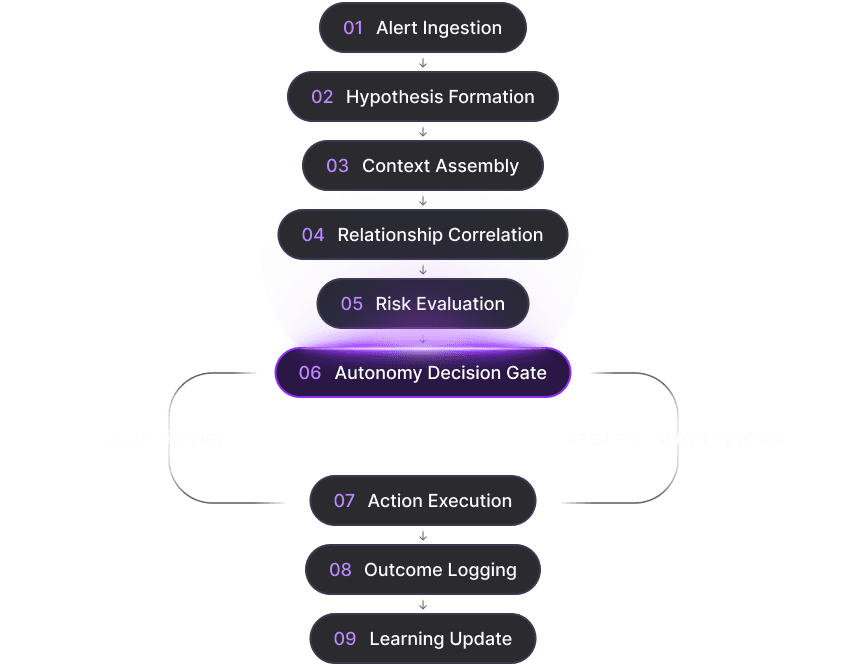
Diagram: End-to-End Decision Pipeline

4. Architectural Overview

An AI-native SOC is not a collection of tools. It is a decision pipeline composed of reasoning, context, memory, execution, and learning layers—each isolated to reduce fragility.

Diagram: End-to-End Decision Pipeline

4. Architectural Overview

An AI-native SOC is not a collection of tools. It is a decision pipeline composed of reasoning, context, memory, execution, and learning layers—each isolated to reduce fragility.

Diagram: End-to-End Decision Pipeline

5. Decision Flow: A Real Operational Trace

Consider a suspicious OAuth consent event on a privileged identity. The system forms a hypothesis, injects context, evaluates blast radius, applies autonomy rules, executes permitted actions, and records outcomes for learning—within seconds.

Decision Trace:

OAuth token revoked automatically. Account suspension escalated for approval. Full rationale logged for audit and learning.

6. Agents as the Execution Primitive

Agents execute intent rather than paths. They operate independently, fail in isolation, and scale horizontally—avoiding the orchestration fragility inherent in workflow systems.

7. Memory, Relationships, and Graph Reasoning

Security is relational. Graph-based memory enables temporal reasoning, blast-radius estimation, and campaign detection—capabilities that flat correlation cannot provide.

8. Learning as a Compounding System Property

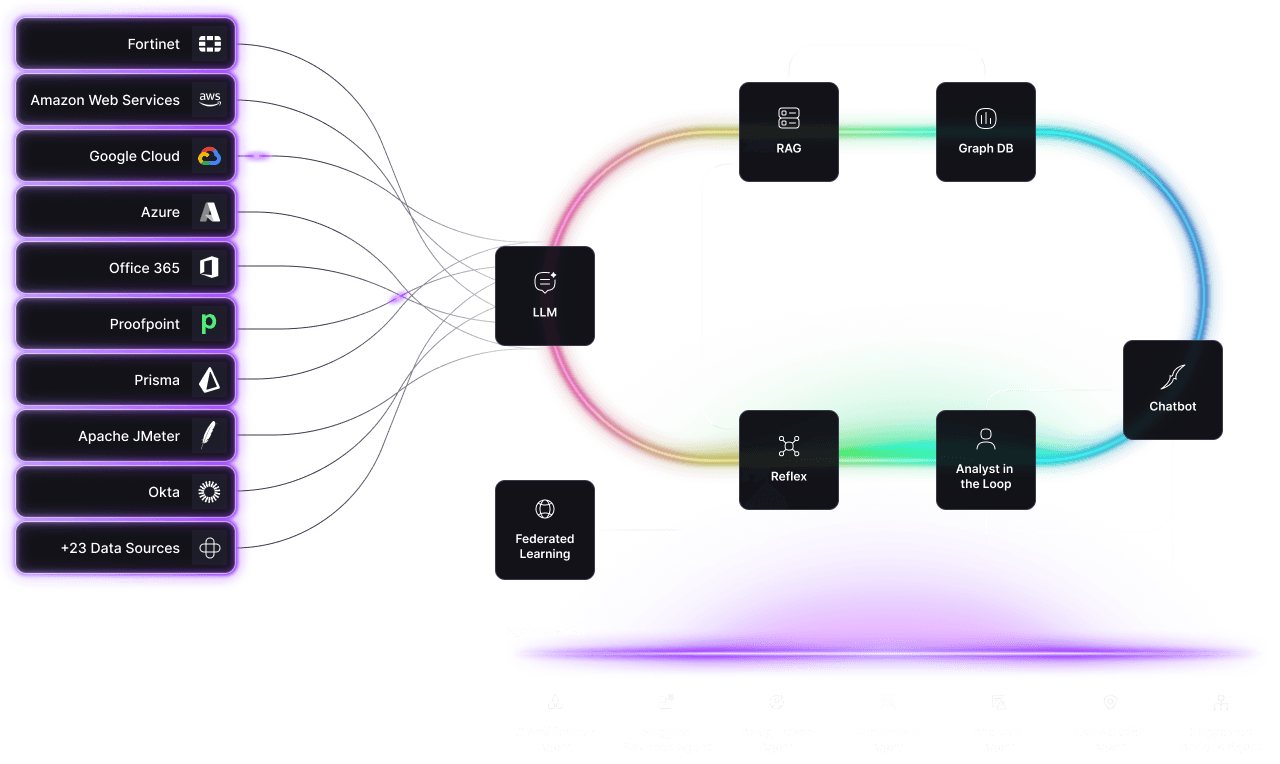
Static systems decay. Learning systems compound. By feeding outcomes back into decision logic, AI-native SOCs improve accuracy and efficiency over time.
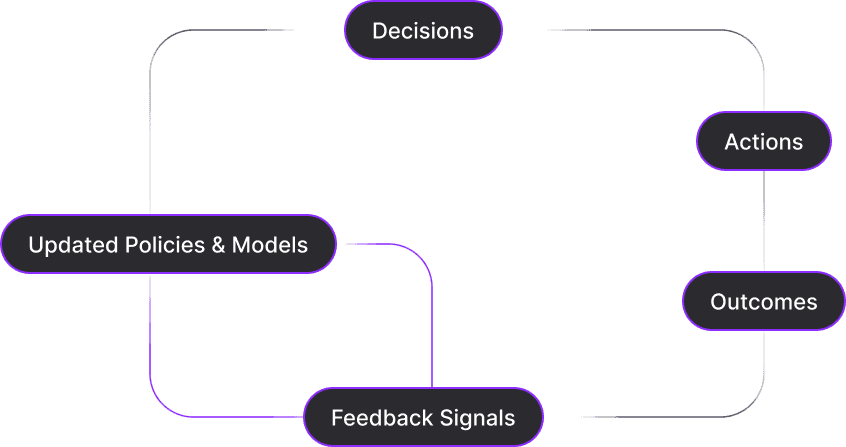
Diagram: Learning Feedback Loops

5. Decision Flow: A Real Operational Trace

Consider a suspicious OAuth consent event on a privileged identity. The system forms a hypothesis, injects context, evaluates blast radius, applies autonomy rules, executes permitted actions, and records outcomes for learning—within seconds.

Decision Trace:

OAuth token revoked automatically. Account suspension escalated for approval. Full rationale logged for audit and learning.

6. Agents as the Execution Primitive

Agents execute intent rather than paths. They operate independently, fail in isolation, and scale horizontally—avoiding the orchestration fragility inherent in workflow systems.

7. Memory, Relationships, and Graph Reasoning

Security is relational. Graph-based memory enables temporal reasoning, blast-radius estimation, and campaign detection—capabilities that flat correlation cannot provide.

8. Learning as a Compounding System Property

Static systems decay. Learning systems compound. By feeding outcomes back into decision logic, AI-native SOCs improve accuracy and efficiency over time.

Diagram: Learning Feedback Loops

5. Decision Flow: A Real Operational Trace

Consider a suspicious OAuth consent event on a privileged identity. The system forms a hypothesis, injects context, evaluates blast radius, applies autonomy rules, executes permitted actions, and records outcomes for learning—within seconds.

Decision Trace:

OAuth token revoked automatically. Account suspension escalated for approval. Full rationale logged for audit and learning.

6. Agents as the Execution Primitive

Agents execute intent rather than paths. They operate independently, fail in isolation, and scale horizontally—avoiding the orchestration fragility inherent in workflow systems.

7. Memory, Relationships, and Graph Reasoning

Security is relational. Graph-based memory enables temporal reasoning, blast-radius estimation, and campaign detection—capabilities that flat correlation cannot provide.

8. Learning as a Compounding System Property

Static systems decay. Learning systems compound. By feeding outcomes back into decision logic, AI-native SOCs improve accuracy and efficiency over time.

Diagram: Learning Feedback Loops

9. Governance, Control, and Trust Boundaries

Autonomy without governance is irresponsible. Control is enforced through policy-bounded actions, risk-tiered approvals, blast-radius constraints, and full auditability.
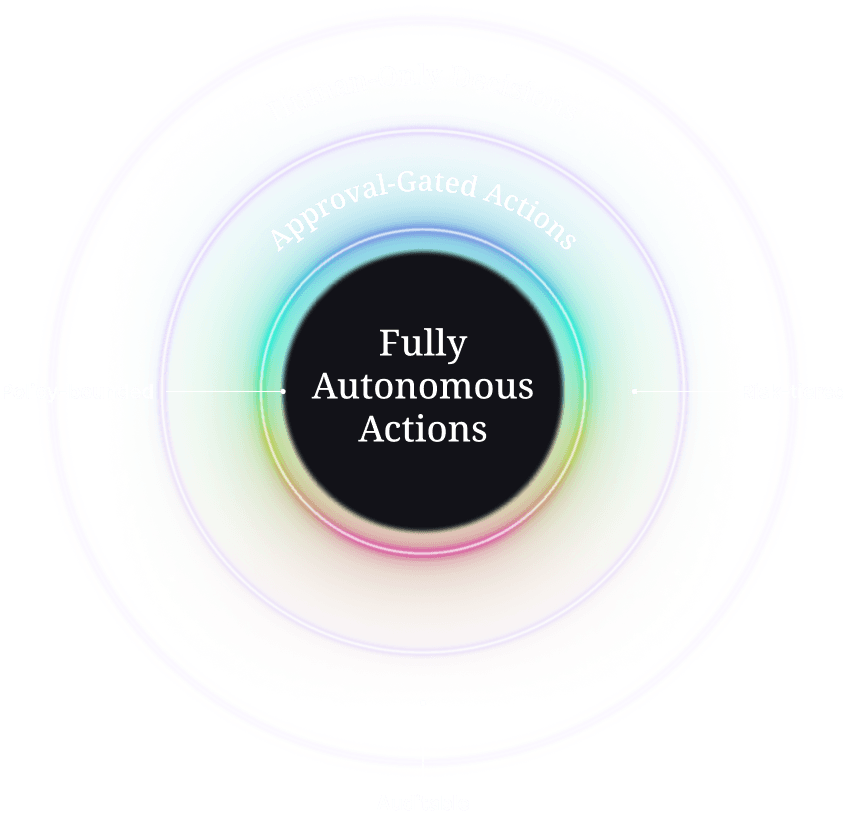
Diagram: Autonomy & Governance Boundaries

9. Governance, Control, and Trust Boundaries

Autonomy without governance is irresponsible. Control is enforced through policy-bounded actions, risk-tiered approvals, blast-radius constraints, and full auditability.

Diagram: Autonomy & Governance Boundaries

9. Governance, Control, and Trust Boundaries

Autonomy without governance is irresponsible. Control is enforced through policy-bounded actions, risk-tiered approvals, blast-radius constraints, and full auditability.

Diagram: Autonomy & Governance Boundaries

10. Why This Architecture Cannot Be Retrofitted

Legacy platforms are built around static workflows and human-first control. These foundations cannot support learning autonomy through incremental change.

Closing Perspective

The future SOC will not be defined by dashboards or headcount. It will be defined by systems that reason in context, act with restraint, learn continuously, and scale without humans as the bottleneck.

© SIRP. This whitepaper reflects the technical perspective of the author and is published for educational and architectural discussion.

10. Why This Architecture Cannot Be Retrofitted

Legacy platforms are built around static workflows and human-first control. These foundations cannot support learning autonomy through incremental change.

Closing Perspective

The future SOC will not be defined by dashboards or headcount. It will be defined by systems that reason in context, act with restraint, learn continuously, and scale without humans as the bottleneck.

© SIRP. This whitepaper reflects the technical perspective of the author and is published for educational and architectural discussion.

10. Why This Architecture Cannot Be Retrofitted

Legacy platforms are built around static workflows and human-first control. These foundations cannot support learning autonomy through incremental change.

Closing Perspective

The future SOC will not be defined by dashboards or headcount. It will be defined by systems that reason in context, act with restraint, learn continuously, and scale without humans as the bottleneck.

© SIRP. This whitepaper reflects the technical perspective of the author and is published for educational and architectural discussion.

Self-driving SOC — governed, AI-native security operations.
Powered by OmniSense™

United States

7735 Old Georgetown Rd, Suite 510

Bethesda, MD 20814

+1 888 701 9252

United Kingdom

167-169 Great Portland Street,

5th Floor, London, W1W 5PF

© 2026 SIRP Labs Inc. All Rights Reserved.

Self-driving SOC — governed, AI-native security operations.
Powered by OmniSense™

United States

7735 Old Georgetown Rd, Suite 510

Bethesda, MD 20814

+1 888 701 9252

United Kingdom

167-169 Great Portland Street,

5th Floor, London, W1W 5PF

© 2026 SIRP Labs Inc. All Rights Reserved.

Self-driving SOC — governed, AI-native security operations.
Powered by OmniSense™

United States

7735 Old Georgetown Rd,
Suite 510, Bethesda, MD 20814

+1 888 701 9252

United Kingdom

167-169 Great Portland Street,
5th Floor, London, W1W 5PF

© 2026 SIRP Labs Inc. All Rights Reserved.