The Continuous Decision System Behind SIRP
How Autonomous SOC Works
An Autonomous SOC is a security operations model where AI systems independently detect, investigate, decide, and respond to defined classes of incidents within governance boundaries.
Unlike traditional SOAR platforms that automate static workflows, an Autonomous SOC evaluates live context, computes risk dynamically, selects a response, and executes actions based on policy and confidence thresholds.
The goal is not to replace analysts. The goal is to redesign how security decisions are made.
How Autonomous SOC Works
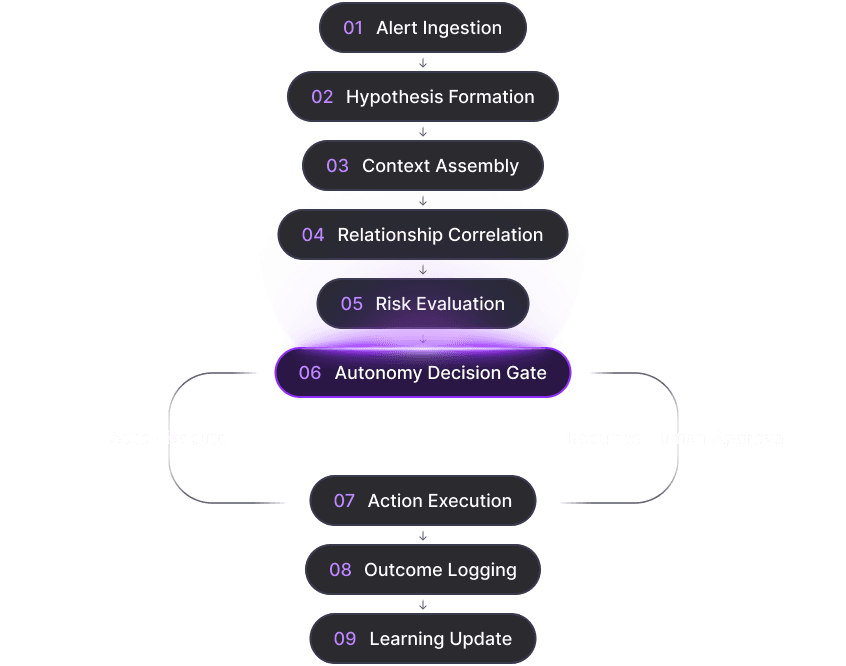
The Continuous Decision System Behind SIRP
An Autonomous SOC operates as a continuous security decision system.
Instead of routing alerts through manual queues and static workflows, SIRP continuously ingests signals, constructs relational context, computes risk, enforces policy boundaries, executes response actions, and learns from every outcome — in real time.
This page explains how that decision loop operates.
An Autonomous SOC is a security operations model where AI systems independently detect, investigate, decide, and respond to defined classes of incidents within governance boundaries.
Unlike traditional SOAR platforms that automate static workflows, an Autonomous SOC evaluates live context, computes risk dynamically, selects a response, and executes actions based on policy and confidence thresholds.
The goal is not to replace analysts. The goal is to redesign how security decisions are made.
Architecture Overview
A Continuous Security Decision Pipeline
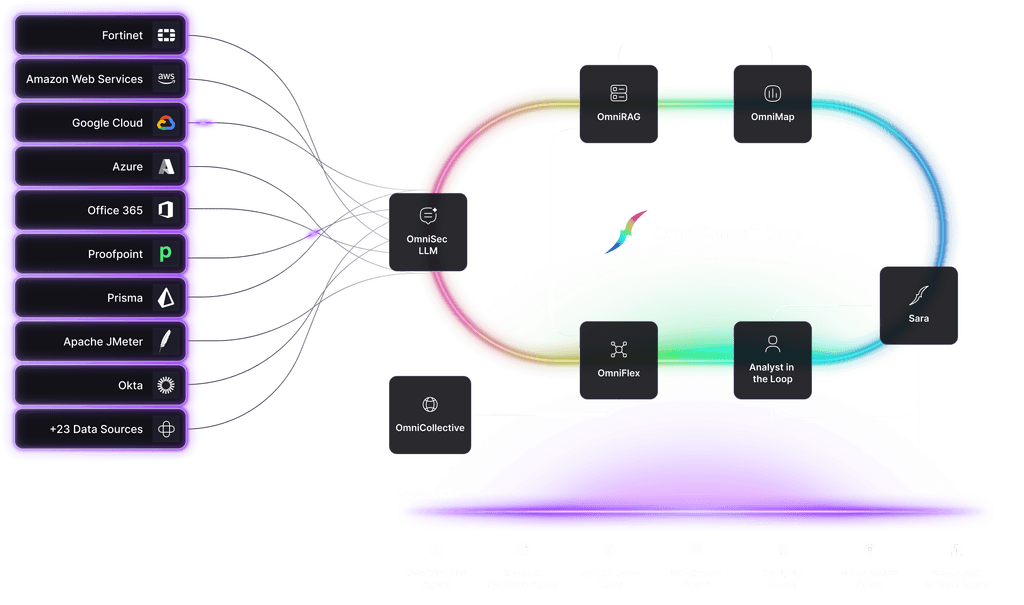
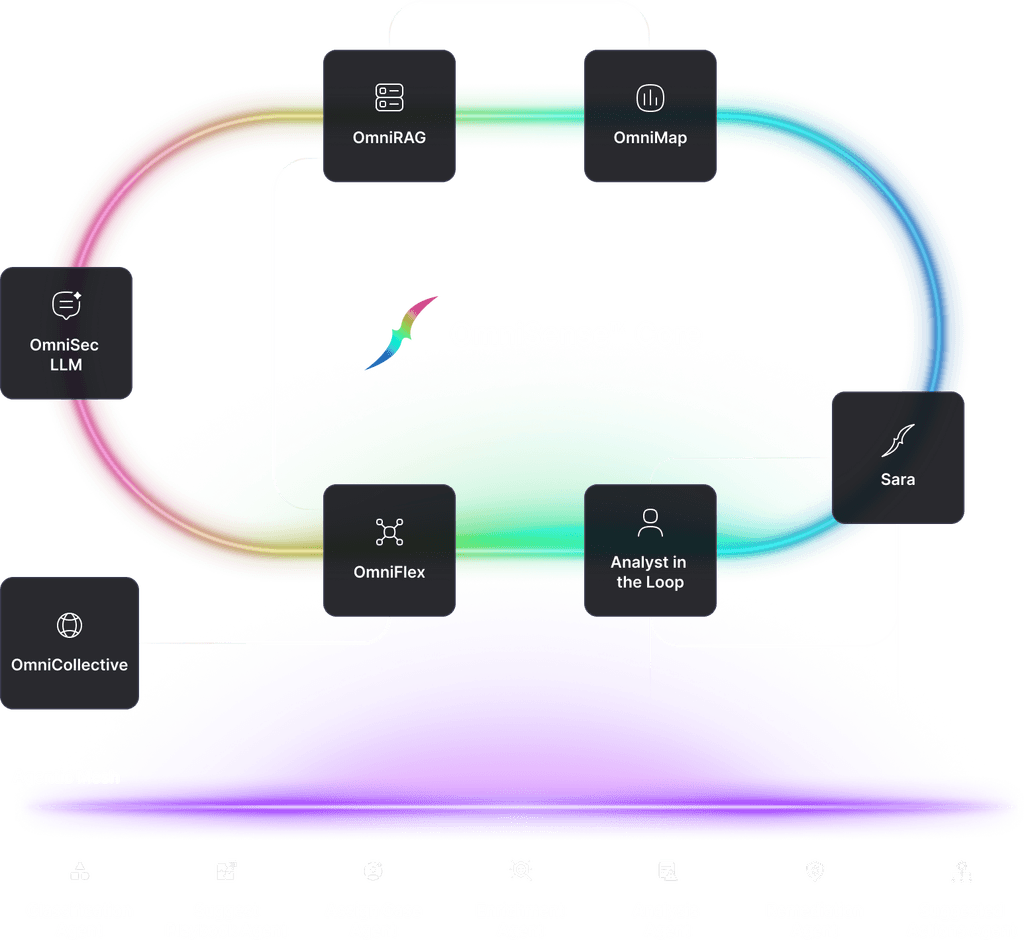
SIRP functions as a closed-loop Autonomous SOC built around six core layers:
Signal ingestion
Relational context construction (OmniMap)
Risk evaluation (OmniSense)
Policy validation
Autonomous execution (Agentic Mesh)
Decision memory and learning (OmniFlex)
These layers operate continuously as environment state changes.
Security operations are not processed per ticket — they are evaluated as an evolving system state.
SIRP functions as a closed-loop Autonomous SOC built around six core layers:
Signal ingestion
Relational context construction (OmniMap)
Risk evaluation (OmniSense)
Policy validation
Autonomous execution (Agentic Mesh)
Decision memory and learning (OmniFlex)
These layers operate continuously as environment state changes.
Security operations are not processed per ticket — they are evaluated as an evolving system state.
Step 1: Signal Ingestion
Continuous Telemetry Across the Environment
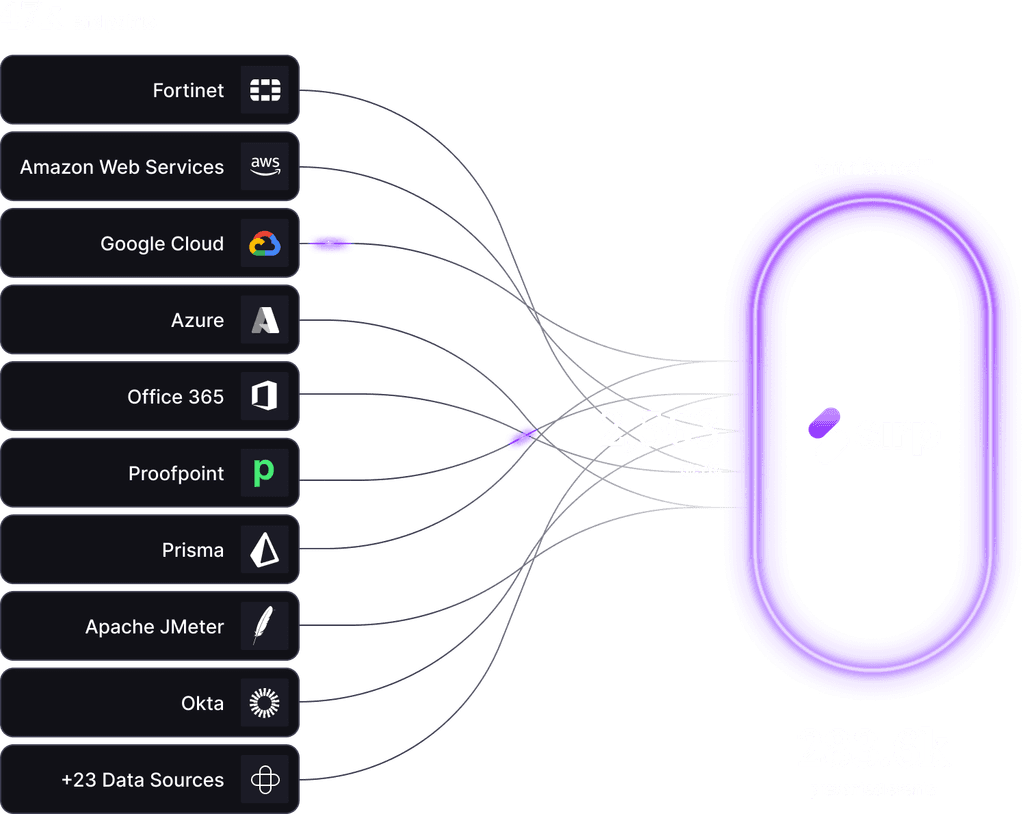
SIRP continuously ingests telemetry from across the security ecosystem, including:
Identity providers and access systems
Endpoints and device telemetry
Cloud infrastructure and SaaS platforms
Network security controls
Threat intelligence feeds
Asset and vulnerability platforms
Existing SIEM, EDR, IAM, and XDR systems
Signals are normalized into structured entities.
Identities, assets, devices, sessions, and behaviors become part of a unified operational model.
This ensures complete, real-time visibility into environment state.
SIRP continuously ingests telemetry from across the security ecosystem, including:
Identity providers and access systems
Endpoints and device telemetry
Cloud infrastructure and SaaS platforms
Network security controls
Threat intelligence feeds
Asset and vulnerability platforms
Existing SIEM, EDR, IAM, and XDR systems
Signals are normalized into structured entities.
Identities, assets, devices, sessions, and behaviors become part of a unified operational model.
This ensures complete, real-time visibility into environment state.
SIRP continuously ingests telemetry from across the security ecosystem, including:
Identity providers and access systems
Endpoints and device telemetry
Cloud infrastructure and SaaS platforms
Network security controls
Threat intelligence feeds
Asset and vulnerability platforms
Existing SIEM, EDR, IAM, and XDR systems
Signals are normalized into structured entities.
Identities, assets, devices, sessions, and behaviors become part of a unified operational model.
This ensures complete, real-time visibility into environment state.
Step 2: Relational Context Construction
OmniMap Security Knowledge Graph
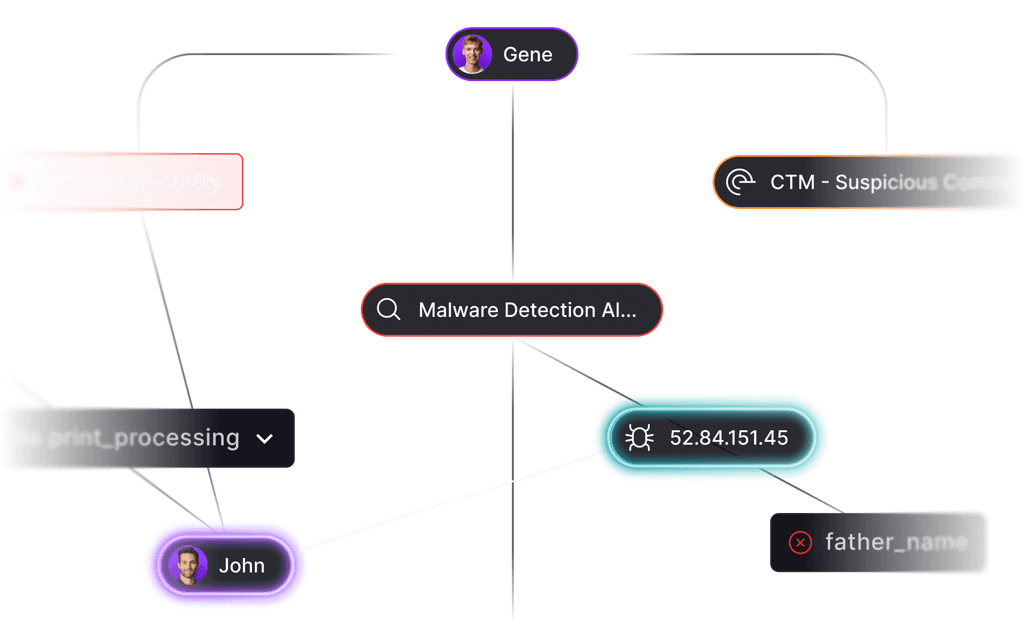
Security is relational. Risk rarely exists in isolation.
OmniMap continuously builds and updates a security knowledge graph that connects:
Identities and privilege relationships
Devices and asset ownership
Cloud workloads and services
Applications and access paths
Historical incidents and prior responses
This relational intelligence enables:
Blast radius estimation
Exposure path detection
Cross-domain correlation
Campaign pattern recognition
Risk is evaluated in context — not as isolated alerts.
Security is relational. Risk rarely exists in isolation.
OmniMap continuously builds and updates a security knowledge graph that connects:
Identities and privilege relationships
Devices and asset ownership
Cloud workloads and services
Applications and access paths
Historical incidents and prior responses
This relational intelligence enables:
Blast radius estimation
Exposure path detection
Cross-domain correlation
Campaign pattern recognition
Risk is evaluated in context — not as isolated alerts.
Security is relational. Risk rarely exists in isolation.
OmniMap continuously builds and updates a security knowledge graph that connects:
Identities and privilege relationships
Devices and asset ownership
Cloud workloads and services
Applications and access paths
Historical incidents and prior responses
This relational intelligence enables:
Blast radius estimation
Exposure path detection
Cross-domain correlation
Campaign pattern recognition
Risk is evaluated in context — not as isolated alerts.
Step 3: Risk Evaluation
OmniSense Decision Engine
OmniSense continuously evaluates system state and determines appropriate response actions.
It computes risk dynamically using factors such as:
Behavioral deviation from baseline
Threat intelligence correlation
Identity privilege level
Asset sensitivity and exposure
Relationship paths identified by OmniMap
Historical decision outcomes
For every evaluated event, OmniSense determines:
Risk score
Confidence level
Eligible response actions
Execution authorization based on policy
This enables SIRP to determine when containment, restriction, escalation, or investigation is required.
OmniSense continuously evaluates system state and determines appropriate response actions.
It computes risk dynamically using factors such as:
Behavioral deviation from baseline
Threat intelligence correlation
Identity privilege level
Asset sensitivity and exposure
Relationship paths identified by OmniMap
Historical decision outcomes
For every evaluated event, OmniSense determines:
Risk score
Confidence level
Eligible response actions
Execution authorization based on policy
This enables SIRP to determine when containment, restriction, escalation, or investigation is required.
OmniSense continuously evaluates system state and determines appropriate response actions.
It computes risk dynamically using factors such as:
Behavioral deviation from baseline
Threat intelligence correlation
Identity privilege level
Asset sensitivity and exposure
Relationship paths identified by OmniMap
Historical decision outcomes
For every evaluated event, OmniSense determines:
Risk score
Confidence level
Eligible response actions
Execution authorization based on policy
This enables SIRP to determine when containment, restriction, escalation, or investigation is required.
Step 4: Policy Validation
Governance Before Execution
Autonomy is never unconditional.
Before execution, every decision is evaluated against defined governance policies.
Policies define:
Permitted autonomous actions
Risk thresholds for containment
Asset-specific protection constraints
Identity-specific limitations
Escalation requirements
Execution authority is determined by policy tier, risk level, and confidence threshold.
If policy conditions are satisfied, response proceeds automatically.
If not, escalation is triggered.
Governance is embedded — not external.
Autonomy is never unconditional.
Before execution, every decision is evaluated against defined governance policies.
Policies define:
Permitted autonomous actions
Risk thresholds for containment
Asset-specific protection constraints
Identity-specific limitations
Escalation requirements
Execution authority is determined by policy tier, risk level, and confidence threshold.
If policy conditions are satisfied, response proceeds automatically.
If not, escalation is triggered.
Governance is embedded — not external.
Autonomy is never unconditional.
Before execution, every decision is evaluated against defined governance policies.
Policies define:
Permitted autonomous actions
Risk thresholds for containment
Asset-specific protection constraints
Identity-specific limitations
Escalation requirements
Execution authority is determined by policy tier, risk level, and confidence threshold.
If policy conditions are satisfied, response proceeds automatically.
If not, escalation is triggered.
Governance is embedded — not external.
Step 5: Autonomous Execution
Agentic Mesh Response Layer
SIRP’s Agentic Mesh executes response actions across integrated security systems.
Agents perform actions such as:
Endpoint isolation
Identity restriction or access revocation
Session termination
Network containment
Cloud workload isolation
Automated investigation workflows
Execution occurs immediately when governance and confidence conditions are met.
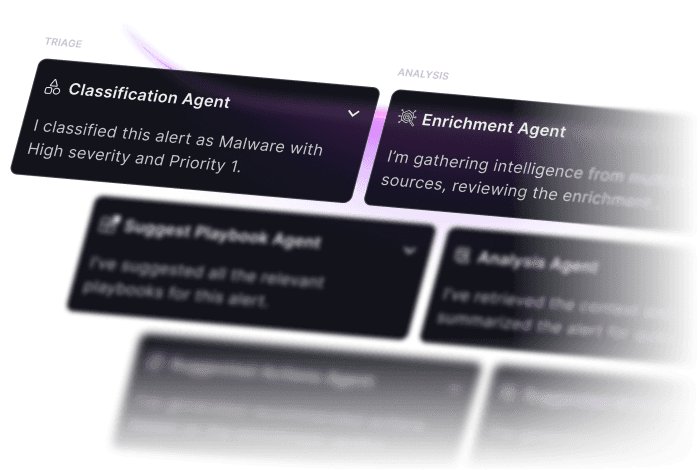
After execution, system state updates automatically — and the decision loop continues.
SIRP’s Agentic Mesh executes response actions across integrated security systems.
Agents perform actions such as:
Endpoint isolation
Identity restriction or access revocation
Session termination
Network containment
Cloud workload isolation
Automated investigation workflows
Execution occurs immediately when governance and confidence conditions are met.
After execution, system state updates automatically — and the decision loop continues.
SIRP’s Agentic Mesh executes response actions across integrated security systems.
Agents perform actions such as:
Endpoint isolation
Identity restriction or access revocation
Session termination
Network containment
Cloud workload isolation
Automated investigation workflows
Execution occurs immediately when governance and confidence conditions are met.
After execution, system state updates automatically — and the decision loop continues.
Step 6: Decision Memory and Learning
Continuous Improvement Through Experience
Every decision is recorded as structured decision memory, including:
Context evaluated
Risk and confidence scores
Actions executed
Execution outcomes
Analyst feedback (when applicable)
This memory feeds back into OmniSense, refining future risk evaluation and response accuracy.
Static systems degrade.
Learning systems compound.
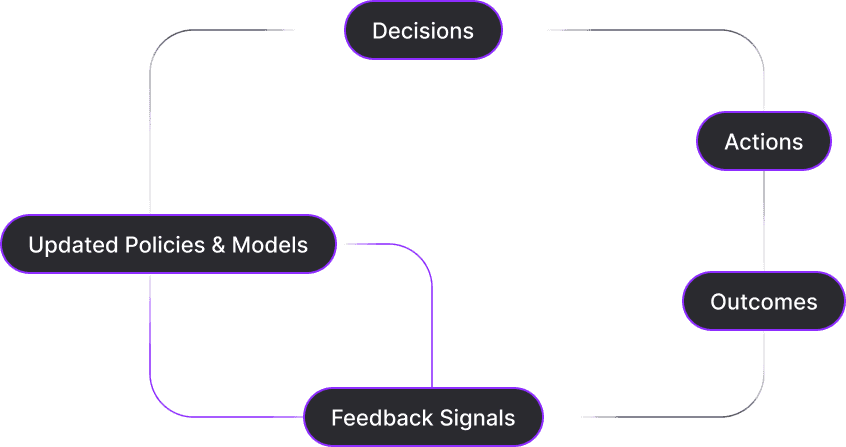
An Autonomous SOC improves as it operates.
Every decision is recorded as structured decision memory, including:
Context evaluated
Risk and confidence scores
Actions executed
Execution outcomes
Analyst feedback (when applicable)
This memory feeds back into OmniSense, refining future risk evaluation and response accuracy.
Static systems degrade.
Learning systems compound.
An Autonomous SOC improves as it operates.
Every decision is recorded as structured decision memory, including:
Context evaluated
Risk and confidence scores
Actions executed
Execution outcomes
Analyst feedback (when applicable)
This memory feeds back into OmniSense, refining future risk evaluation and response accuracy.
Static systems degrade.
Learning systems compound.
An Autonomous SOC improves as it operates.
The Continuous Decision Loop
SIRP operates as a continuous autonomous cycle:
Signals update environment state
Relational context recalculates continuously
Risk recomputes dynamically
Policy validates execution authority
Agents execute permitted actions
Decision memory records outcomes
This loop runs continuously across your environment — not per alert, and not per ticket.
Security operations become a governed system process.
SIRP operates as a continuous autonomous cycle:
Signals update environment state
Relational context recalculates continuously
Risk recomputes dynamically
Policy validates execution authority
Agents execute permitted actions
Decision memory records outcomes
This loop runs continuously across your environment — not per alert, and not per ticket.
Security operations become a governed system process.
SIRP operates as a continuous autonomous cycle:
Signals update environment state
Relational context recalculates continuously
Risk recomputes dynamically
Policy validates execution authority
Agents execute permitted actions
Decision memory records outcomes
This loop runs continuously across your environment — not per alert, and not per ticket.
Security operations become a governed system process.
Deployment and Integration
SIRP operates as a decision layer across existing infrastructure.
It does not replace SIEM, EDR, IAM, or cloud security systems — it governs them.
Supported integrations include:
SIEM platforms
EDR and XDR systems
Identity providers
Cloud security platforms
Network security controls
Threat intelligence feeds
SIRP connects across the existing stack and centralizes decision authority within a governed
SIRP operates as a decision layer across existing infrastructure.
It does not replace SIEM, EDR, IAM, or cloud security systems — it governs them.
Supported integrations include:
SIEM platforms
EDR and XDR systems
Identity providers
Cloud security platforms
Network security controls
Threat intelligence feeds
SIRP connects across the existing stack and centralizes decision authority within a governed
SIRP operates as a decision layer across existing infrastructure.
It does not replace SIEM, EDR, IAM, or cloud security systems — it governs them.
Supported integrations include:
SIEM platforms
EDR and XDR systems
Identity providers
Cloud security platforms
Network security controls
Threat intelligence feeds
SIRP connects across the existing stack and centralizes decision authority within a governed
Operational Outcomes Enabled
This architecture enables organizations to:
Respond immediately to emerging threats
Enforce policy consistently across environments
Reduce incident response latency
Minimize manual routing and approval delays
Improve decision accuracy over time
Maintain governance and auditability
Security operations shift from workflow orchestration to continuous, policy-bound decision systems.
This architecture enables organizations to:
Respond immediately to emerging threats
Enforce policy consistently across environments
Reduce incident response latency
Minimize manual routing and approval delays
Improve decision accuracy over time
Maintain governance and auditability
Security operations shift from workflow orchestration to continuous, policy-bound decision systems.
This architecture enables organizations to:
Respond immediately to emerging threats
Enforce policy consistently across environments
Reduce incident response latency
Minimize manual routing and approval delays
Improve decision accuracy over time
Maintain governance and auditability
Security operations shift from workflow orchestration to continuous, policy-bound decision systems.
See Autonomous SOC in Action
Understand how SIRP ingests telemetry, computes risk, and executes governed response actions across your environment.
Watch your Autonomous SOC drive itself
United States
7735 Old Georgetown Rd, Suite 510
Bethesda, MD 20814
+1 888 701 9252
United Kingdom
167-169 Great Portland Street,
5th Floor, London, W1W 5PF
© 2026 SIRP Labs Inc. All Rights Reserved.
United States
7735 Old Georgetown Rd, Suite 510
Bethesda, MD 20814
+1 888 701 9252
United Kingdom
167-169 Great Portland Street,
5th Floor, London, W1W 5PF
© 2026 SIRP Labs Inc. All Rights Reserved.
United States
7735 Old Georgetown Rd,
Suite 510, Bethesda, MD 20814
+1 888 701 9252
United Kingdom
167-169 Great Portland Street,
5th Floor, London, W1W 5PF


© 2026 SIRP Labs Inc. All Rights Reserved.