" height="251px" id="hiop_AtSC" width="550px"/></g></svg>)
" height="250.9999782649012px" id="ydfzMbSNH" width="550px"/></g></svg>)
" height="251px" id="YYeMjMncw" width="624px"/></g></svg>)
The Declaration
Cybersecurity is running out of headroom.
Every year, the stack gets bigger — more dashboards, more alerts, more “next-gen” promises that mostly mean “next-month’s patch.” Meanwhile, adversaries have gone full machine-speed — automating reconnaissance, weaponizing intelligence, and rewriting tactics in real time.
The people defending the gates aren’t the problem. They’re just outnumbered and undersupported — forced to juggle a hundred blinking panels built for another era. Every integration meant to help only adds more noise. Every dashboard meant to simplify ends up multiplying friction.
We’ve hit a wall. Human cognition is linear; the threat surface isn’t. The era of dashboards is over. The era of decision engines has begun.
The future of defense won’t come from another “AI-enabled” platform that still needs a babysitter. It will come from systems that learn, reason, and act — with accountability and explainability baked in. Systems that improve themselves the longer they operate.
The next-generation SOC won’t be driven by analysts.
It will drive for them.
This is the Self-Driving SOC — built for continuous awareness, autonomous decision-making, and measurable learning.Actually autonomous. Not demo-day autonomous.
Why “AI-Enabled” Isn’t Enough
The cybersecurity industry loves its buzzwords.
Everything today is “AI-powered,” “intelligent,” or “autonomous”—until you open the hood and find the same old rules engine wearing a new coat of machine learning lipstick. These systems don’t think; they trigger. They automate steps, not decisions. They mimic human behavior without ever developing judgment.
Let’s be clear: automation isn’t the enemy. It’s the floor. It helps analysts move faster. But autonomy? That helps security evolve faster. The difference isn’t semantics. It’s architecture. An automated system performs predefined actions when triggered. An autonomous system observes its environment, evaluates context, proposes actions, learns from results, and adjusts future behavior: safely, transparently, and with guardrails intact.
Automation reduces toil.
Autonomy reduces dependence.
To qualify as self-driving, a cybersecurity system has to do more than follow orders. It must master four core disciplines:
Perception: See the battlefield clearly - separate noise from signal, pattern from panic.
Reasoning: Understand context, weigh trade-offs, and justify every choice.
Action: Execute decisions safely, respecting policy, reversibility, and impact.
Learning: Fold outcomes back into reflexes—becoming sharper with every incident.
Without all four, “autonomy” is just a marketing slogan with a GPU bill.
The SOAR Shortfall
SOAR was supposed to simplify. Instead, it buried operations under its own weight. It unified tools but not judgment. Analysts still hop between consoles, stitch together context, manually approve every decision, and hold brittle workflows together every time an API decides to change. The more systems we connected, the more fragmented the picture became.
The numbers tell the story:
Nearly 60% of security leaders report alert volumes they can’t manage.
Over half are overwhelmed by false positives.
84% of organizations say their analysts re-investigate the same incident types multiple times a month.
And despite all this “automation,” global containment times still exceed 200 days.
SOAR automated the stack but not the thinking. It built workflows, not reflexes. The shift from automation to autonomy begins with a simple truth: context, not code, drives good decisions.
A Self-Driving SOC doesn’t wait for analysts to hit Run Playbook. It pulls the right context at the right time, reasons through options, and acts within the guardrails defined by policy.
And every action feeds back into the system.
Response times drop. Containment improves. Confidence compounds.
Over time, analysts step in less — not because they’ve been replaced, but because the system has learned from them. That’s the difference between running a platform and commanding an autonomous defense.
The Autonomy Stack
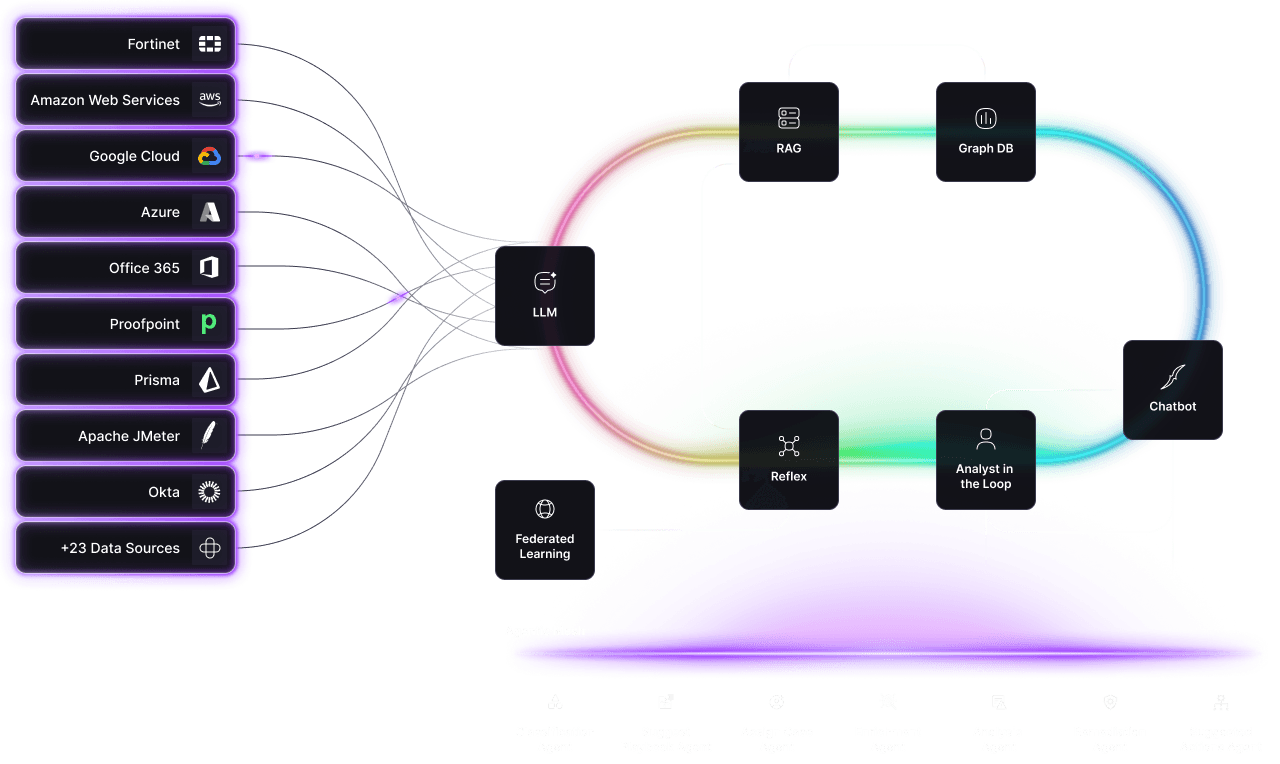
A Self-Driving SOC is not a collection of features — it’s a closed feedback loop. Signals enter, reasoning applies, actions execute safely, and results are reintegrated into the system’s understanding. Each layer feeds the next, creating a continuous cycle of sensing, decision-making, and improvement.
At the center of this architecture sits OmniSense — the intelligence core that powers the loop — surrounded by four complementary systems: OmniMap, OmniCore, OmniFlex, and OmniCollective. Together, they form the Autonomy Stack.
1. OmniSense Core — The Reasoning Engine
Every autonomous system begins with reasoning. OmniSense is a security-tuned decision engine that evaluates evidence, weighs risk, and presents explainable options before acting.
It fuses alert data, historical incidents, asset context, and organizational policies into a structured understanding of the situation. From there, it proposes actions — each with confidence levels, alternative paths, and rationales.
Its intelligence doesn’t come from guesswork, but from context retrieval. When OmniSense acts, it cites its sources: which logs, which indicators, which relationships inform the decision. Each step is traceable, auditable, and reversible.
The outcome is not blind execution but informed autonomy — actions that think before they move.
2. OmniMap — The Shared Memory Graph
Context is the substrate of reasoning. OmniMap maintains that context — a living graph of entities, relationships, vulnerabilities, and privileges.
It allows the system to understand impact paths and dependencies in real time: who owns what, which assets are exposed, and where risk can propagate.
Unlike static CMDBs or dashboards, OmniMap operates dynamically. As alerts flow in, it retrieves relevant context automatically, narrowing focus to the most affected systems.
A decision made in isolation is just automation. A decision made with live context is the beginning of intelligence.
3. OmniCore — The Execution Fabric
Reasoning must lead to controlled action. OmniCore is the execution fabric that translates OmniSense’s intent into safe, verifiable operations across the enterprise.
Through policy-aware playbooks, agentic orchestration, and reversible command flows, OmniCore ensures every decision is enforced deliberately — with rollback, justification, and approval states when required.
This is how autonomy scales without losing control: every action is both authoritative and accountable.
4. OmniFlex — The Learning Reflex Engine
Autonomy without learning is stagnation. OmniFlex closes the loop by continuously evaluating the outcomes of past actions and feeding them back into the system.
It applies reinforcement learning principles to SOC operations — tuning response thresholds, optimizing playbooks, and adapting to environmental shifts.
Every containment, false positive, and escalation becomes a datapoint in an evolving model of organizational behavior. OmniFlex is how the system learns itself into efficiency.
5. OmniCollective — The Federated Intelligence Layer
No SOC defends alone. OmniCollective enables privacy-preserving collaboration across organizations, allowing anonymized intelligence and response strategies to be shared without leaking data.
It builds collective immunity: when one SOC learns, the ecosystem strengthens. This is the foundation of a self-evolving defense fabric — where knowledge circulates faster than threat actors can.
From Automation to Autonomy
The Self-Driving SOC isn’t about removing humans — it’s about removing the repetitive friction that prevents them from thinking strategically.
Analysts shift from operators to supervisors.
Playbooks shift from scripts to evolving policies.
The SOC shifts from reactive to reflexive.
In a world of autonomous attackers, the only sustainable defense is an autonomous response.
The Call to Responsibility
Autonomy demands accountability. Trust must be engineered, not assumed.
The Self-Driving SOC must explain its reasoning, respect its boundaries, and remain reversible at every step. Transparency, auditability, and human-defined guardrails aren’t optional — they are the foundations of engineered trust.
Autonomy isn’t the absence of humans. It’s the amplification of human intent.
The Future Is Self-Driving
The defenders’ edge will not come from more dashboards or more data. It will come from systems that see, think, and act — faster than the adversary, and safer than the past.
The next SOC will not wait for direction.
It will sense. It will reason. It will act. It will learn.
Welcome to the Self-Driving SOC. Welcome to OmniSense.