"/><stop offset="1" stop-color="rgb(185, 138, 255)"/></linearGradient></defs><path d="M 5.507 0.292 C 5.72 -0.097 6.279 -0.097 6.492 0.292 L 7.558 2.239 L 9.687 1.616 C 10.113 1.492 10.508 1.887 10.384 2.313 L 9.76 4.442 L 11.708 5.508 C 12.097 5.721 12.097 6.279 11.708 6.492 L 9.76 7.558 L 10.384 9.689 C 10.508 10.114 10.113 10.51 9.687 10.386 L 7.557 9.761 L 6.492 11.708 C 6.279 12.097 5.72 12.097 5.507 11.708 L 4.442 9.761 L 2.311 10.386 C 1.886 10.51 1.491 10.114 1.615 9.689 L 2.239 7.557 L 0.292 6.492 C -0.097 6.279 -0.097 5.721 0.292 5.508 L 2.238 4.442 L 1.615 2.313 C 1.491 1.887 1.886 1.492 2.311 1.616 L 4.441 2.239 Z M 6.246 7.45 C 6.14 7.256 5.86 7.256 5.754 7.45 L 5.685 7.574 C 5.66 7.621 5.621 7.66 5.574 7.686 L 5.45 7.754 C 5.256 7.861 5.256 8.14 5.45 8.246 L 5.574 8.315 C 5.621 8.34 5.66 8.379 5.685 8.426 L 5.754 8.55 C 5.86 8.744 6.139 8.744 6.246 8.55 L 6.314 8.426 C 6.34 8.379 6.379 8.34 6.426 8.315 L 6.55 8.246 C 6.744 8.14 6.744 7.861 6.55 7.754 L 6.426 7.686 C 6.379 7.66 6.34 7.621 6.314 7.574 Z M 5.59 3.5 C 5.281 3.5 5.046 3.778 5.097 4.082 L 5.431 6.082 C 5.471 6.323 5.679 6.5 5.924 6.5 L 6.076 6.5 C 6.32 6.5 6.529 6.323 6.569 6.082 L 6.903 4.082 C 6.954 3.778 6.719 3.5 6.41 3.5 Z" fill="url(%23fOrgJ9pJo-1114658454-linear-gradient)" height="12.000038100000001px" id="fOrgJ9pJo" transform="translate(0 0)" width="11.999598075112768px"/></svg>)
" height="251px" id="hiop_AtSC" width="550px"/></g></svg>)
" height="250.9999782649012px" id="ydfzMbSNH" width="550px"/></g></svg>)
" height="251px" id="YYeMjMncw" width="624px"/></g></svg>)
Autonomous Security:
From Playbooks to Decision Systems
Actually autonomous
Security Operations Centers were not designed for the world they now operate in.
They were built for episodic threats, manageable alert volumes, and human-paced decision-making. Over time, those assumptions quietly broke. Threats became continuous. Alerts multiplied. Attackers automated. Defenders compensated with more tools, more dashboards, more people — and more process.
The result was not resilience.
It was fragility at scale.
This page explains why the SOC model reached its limits, why automation failed to save it, and why the future of security operations belongs to governed, AI-native decision systems — not workflows.
The Core Problem: Decision Bottlenecks at Machine Scale
The Core Problem: Decision Bottlenecks at Machine Scale
The Core Problem: Decision Bottlenecks at Machine Scale
Modern security environments generate more signals than any human team can reliably process. Each alert requires context — identity, asset criticality, historical behavior, and environmental state — yet this context is fragmented across systems and reconstructed manually.
Modern security environments generate more signals than any human team can reliably process. Each alert requires context — identity, asset criticality, historical behavior, and environmental state — yet this context is fragmented across systems and reconstructed manually.
As volume increases, teams compensate by simplifying decisions, relying on heuristics, or deferring action. Variance becomes inevitable:
As volume increases, teams compensate by simplifying decisions, relying on heuristics, or deferring action. Variance becomes inevitable:
Different analysts reach different conclusions
Context is lost across shifts
Fatigue degrades judgment
Response times fluctuate unpredictably
Different analysts reach different conclusions
Context is lost across shifts
Fatigue degrades judgment
Response times fluctuate unpredictably
This is not a failure of skill or effort.
This is not a failure of skill or effort.
Security broke when decisions remained human-bounded while threats became machine-scaled.
Security broke when decisions remained human-bounded while threats became machine-scaled.
Why Automation and SOAR Were Not Enough
Automation promised relief by accelerating response. In practice, it accelerated execution while preserving static decision logic.
Automation promised relief by accelerating response. In practice, it accelerated execution while preserving static decision logic.
Playbooks assume that future threats resemble past ones. They encode known paths for known conditions. In environments defined by novelty and adaptation, exceptions dominate. Playbooks multiply. Maintenance overhead grows. Cognitive load shifts from execution to orchestration.
Playbooks assume that future threats resemble past ones. They encode known paths for known conditions. In environments defined by novelty and adaptation, exceptions dominate. Playbooks multiply. Maintenance overhead grows. Cognitive load shifts from execution to orchestration.
Automation reduces keystrokes.
It does not reduce decision complexity.
Automation reduces keystrokes.
It does not reduce decision complexity.
Systems designed to execute predefined instructions cannot evolve into systems that reason. Adding AI to workflows does not change this constraint — because the foundation remains static.
Systems designed to execute predefined instructions cannot evolve into systems that reason. Adding AI to workflows does not change this constraint — because the foundation remains static.
This is why SOAR reached a ceiling.
This is why SOAR reached a ceiling.
Why the Industry Is Rebuilding, Not Optimizing
The current wave of cybersecurity consolidation is often described as optimization or tool sprawl reduction. That framing misses the deeper shift underway.
The current wave of cybersecurity consolidation is often described as optimization or tool sprawl reduction. That framing misses the deeper shift underway.
Across recent strategic acquisitions and platform consolidation, buyers are no longer prioritizing incremental detection, additional controls, or workflow automation. They are responding to a more fundamental realization: the security operating model itself no longer scales.
Across recent strategic acquisitions and platform consolidation, buyers are no longer prioritizing incremental detection, additional controls, or workflow automation. They are responding to a more fundamental realization: the security operating model itself no longer scales.
As alert volumes became multi-stage attack chains and human decision loops became the bottleneck, optimization stopped being sufficient. The industry has entered a rebuild phase — moving away from alert handling toward governed decision systems designed to operate at machine speed with human oversight.
As alert volumes became multi-stage attack chains and human decision loops became the bottleneck, optimization stopped being sufficient. The industry has entered a rebuild phase — moving away from alert handling toward governed decision systems designed to operate at machine speed with human oversight.
We explore this shift, and what it signals about the future security platform landscape, in more detail here:
We explore this shift, and what it signals about the future security platform landscape, in more detail here:
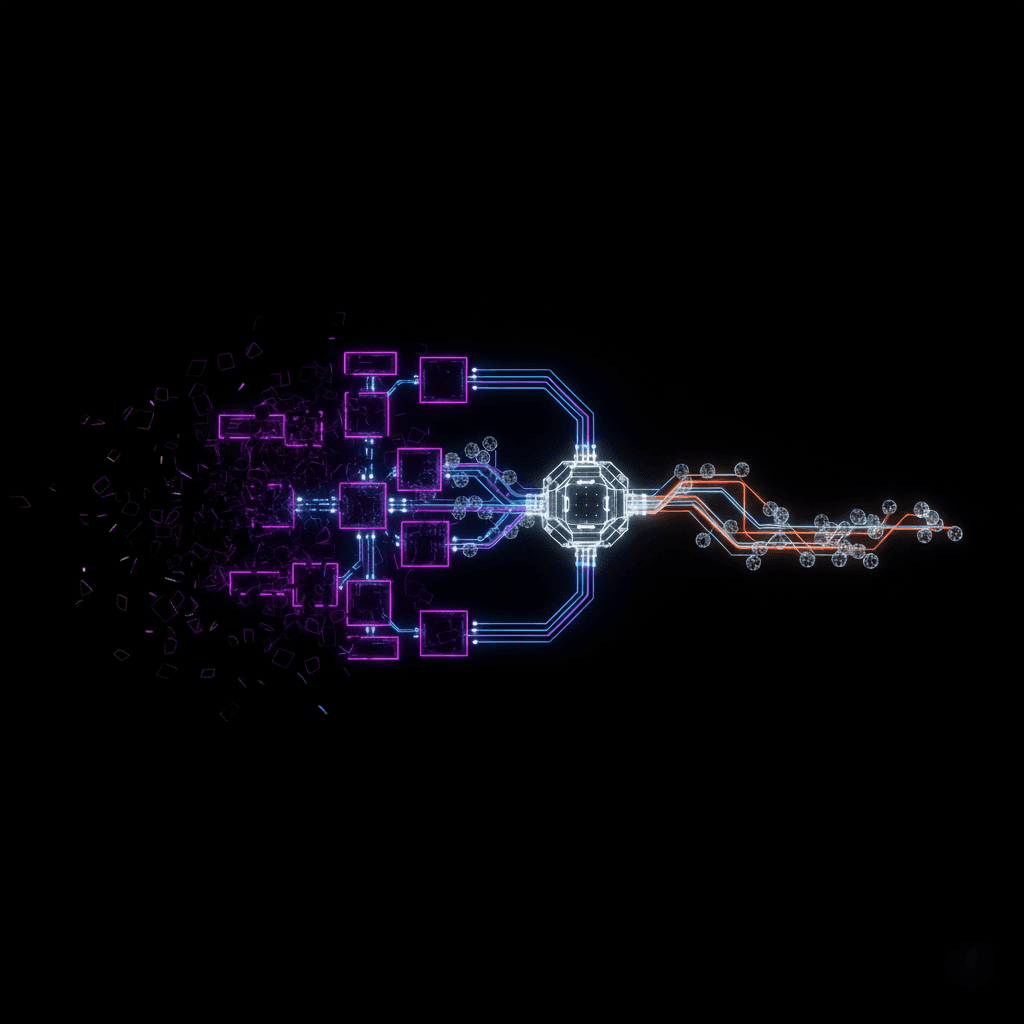
The Architectural Shift: From Workflows to Decision Systems
AI-native security does not optimize workflows.
It replaces them with decision pipelines.
Instead of humans triaging everything, systems:
AI-native security does not optimize workflows.
It replaces them with decision pipelines.
Instead of humans triaging everything, systems:
Form hypotheses about what is happening
Assemble context automatically
Evaluate risk in relation to blast radius
Decide whether action is permitted
Execute within defined boundaries
Learn from outcomes
Form hypotheses about what is happening
Assemble context automatically
Evaluate risk in relation to blast radius
Decide whether action is permitted
Execute within defined boundaries
Learn from outcomes
Humans do not disappear.
They move from execution to governance.
Humans do not disappear.
They move from execution to governance.
This shift changes the nature of the SOC from a queue-driven operation into a continuously operating system that senses, reasons, acts, and learns.
This shift changes the nature of the SOC from a queue-driven operation into a continuously operating system that senses, reasons, acts, and learns.

Autonomy Does Not Mean Loss of Control
Autonomy Does Not Mean Loss of Control
One of the most common objections to autonomous security is fear of uncontrolled action. That fear is understandable — but misplaced.
Human-driven SOCs already operate with significant uncontrolled variance:
One of the most common objections to autonomous security is fear of uncontrolled action. That fear is understandable — but misplaced.
Human-driven SOCs already operate with significant uncontrolled variance:
Decisions are undocumented
Judgment differs across analysts
Exceptions are handled inconsistently
Fatigue changes outcomes
AI-native systems, when designed correctly, are more controllable, not less.
Decisions are undocumented
Judgment differs across analysts
Exceptions are handled inconsistently
Fatigue changes outcomes
AI-native systems, when designed correctly, are more controllable, not less.
Governed autonomy is enforced through:
Policy-bounded actions
Risk-tiered approval gates
Explicit blast-radius limits
Full auditability of decisions
Kill switches and graceful degradation
Autonomy is not a binary switch.
It is a spectrum — deliberately designed.
Read more:
→ Autonomous Security Does Not Mean Uncontrolled Security
Governed autonomy is enforced through:
Policy-bounded actions
Risk-tiered approval gates
Explicit blast-radius limits
Full auditability of decisions
Kill switches and graceful degradation
Autonomy is not a binary switch.
It is a spectrum — deliberately designed.
Read more:
→ Autonomous Security Does Not Mean Uncontrolled Security
The Economic Reality That Forces the Shift
Human-centric SOCs scale linearly.
Threats do not.
Each additional alert consumes analyst attention, increases fatigue, and raises the probability of error. Spikes create backlogs. Backlogs increase risk. Costs rise predictably while outcomes remain variable.
AI-native SOCs change the economics by changing where decisions are made.
Human-centric SOCs scale linearly.
Threats do not.
Each additional alert consumes analyst attention, increases fatigue, and raises the probability of error. Spikes create backlogs. Backlogs increase risk. Costs rise predictably while outcomes remain variable.
AI-native SOCs change the economics by changing where decisions are made.
In this model:
Alerts stop being “work” and become “input”
Spikes become learning events, not stress events
Marginal cost per alert approaches zero
Outcomes become more predictable over time
In this model:
Alerts stop being “work” and become “input”
Spikes become learning events, not stress events
Marginal cost per alert approaches zero
Outcomes become more predictable over time
Security becomes economically sustainable — not just cheaper.
Read more:
→ The Economics of an AI-Native SOC
Security becomes economically sustainable — not just cheaper.
Read more:
→ The Economics of an AI-Native SOC


The CISO’s Real Risk Has Changed
Historically, CISOs were rewarded for caution. Today, hesitation carries its own risk.
Historically, CISOs were rewarded for caution. Today, hesitation carries its own risk.
Boards no longer ask only whether controls exist. They ask whether security models can adapt. Post-incident reviews rarely focus on why innovation failed — they focus on why modernization never happened.
Boards no longer ask only whether controls exist. They ask whether security models can adapt. Post-incident reviews rarely focus on why innovation failed — they focus on why modernization never happened.
The greatest career risk today is not adopting AI too early.
It is standing still while the threat model changes.
Read more:
The greatest career risk today is not adopting AI too early.
It is standing still while the threat model changes.
Read more:
Where Humans Still Matter — and Always Will
AI-native security does not remove human responsibility. It refocuses it.
Humans remain essential for:
AI-native security does not remove human responsibility. It refocuses it.
Humans remain essential for:
Defining policy and acceptable risk
Governing autonomy boundaries
Handling business-critical decisions
Auditing and accountability
Strategic threat understanding
Defining policy and acceptable risk
Governing autonomy boundaries
Handling business-critical decisions
Auditing and accountability
Strategic threat understanding
The future SOC is not human-free.
It is human-on-the-loop, not human-in-the-loop.
The future SOC is not human-free.
It is human-on-the-loop, not human-in-the-loop.

From Tools to Systems
From Tools to Systems
For decades, security has attempted to scale by adding tools to a model that no longer fits reality. The next decade will belong to systems that:
For decades, security has attempted to scale by adding tools to a model that no longer fits reality. The next decade will belong to systems that:
Reason in context
Act with restraint
Learn continuously
Scale without humans as the bottleneck
Reason in context
Act with restraint
Learn continuously
Scale without humans as the bottleneck
Security broke when decisions remained human-bounded while threats became machine-scaled.
Security broke when decisions remained human-bounded while threats became machine-scaled.
Go Deeper
Go Deeper
Read the Technical Whitepaper
An AI-Native Architecture for Autonomous Security Operations
Read the Technical Whitepaper
An AI-Native Architecture for Autonomous Security Operations
"/><stop offset="1" stop-color="rgb(185, 138, 255)"/></linearGradient></defs><path d="M 10.622 6.705 C 10.623 6.704 10.623 6.702 10.623 6.701 C 10.655 6.472 10.68 6.244 10.68 6.009 C 10.68 5.91 10.676 5.81 10.669 5.711 C 10.648 5.439 10.734 5.165 10.931 4.976 L 11.308 4.613 C 11.586 4.346 11.645 3.922 11.449 3.59 L 10.748 2.399 C 10.558 2.076 10.176 1.92 9.814 2.017 L 9.238 2.172 C 8.985 2.24 8.717 2.181 8.498 2.038 C 8.322 1.924 8.138 1.821 7.947 1.729 C 7.706 1.614 7.516 1.409 7.447 1.151 L 7.304 0.618 C 7.206 0.253 6.876 0 6.499 0 L 5.06 0 C 4.683 0 4.352 0.253 4.255 0.618 L 4.112 1.151 C 4.043 1.409 3.853 1.614 3.612 1.729 C 3.418 1.823 3.232 1.927 3.053 2.044 C 2.834 2.187 2.567 2.247 2.315 2.18 L 1.739 2.027 C 1.377 1.931 0.995 2.089 0.806 2.413 L 0.113 3.602 C -0.081 3.935 -0.021 4.357 0.257 4.623 L 0.638 4.988 C 0.836 5.177 0.923 5.452 0.902 5.725 C 0.895 5.821 0.891 5.918 0.891 6.015 C 0.891 6.114 0.895 6.208 0.902 6.3 C 0.921 6.566 0.834 6.831 0.642 7.015 L 0.259 7.381 C -0.02 7.648 -0.079 8.072 0.117 8.406 L 0.817 9.595 C 1.007 9.918 1.389 10.075 1.751 9.978 L 2.282 9.836 C 2.539 9.767 2.81 9.829 3.032 9.975 C 3.221 10.099 3.419 10.21 3.625 10.308 C 3.866 10.423 4.055 10.629 4.124 10.886 L 4.256 11.381 C 4.353 11.746 4.683 12 5.061 12 L 6.498 12 C 6.876 12 7.206 11.746 7.303 11.381 L 7.434 10.889 C 7.503 10.63 7.694 10.424 7.936 10.308 C 8.145 10.208 8.344 10.095 8.534 9.969 C 8.755 9.822 9.026 9.761 9.282 9.829 L 9.819 9.972 C 10.182 10.068 10.564 9.911 10.753 9.587 L 11.451 8.392 C 11.645 8.059 11.586 7.636 11.307 7.37 L 10.622 6.714 C 10.619 6.711 10.619 6.707 10.622 6.705 Z M 5.789 7.894 C 4.389 7.894 3.855 7.385 3.855 6.015 C 3.855 4.646 4.389 4.137 5.789 4.137 C 7.189 4.137 7.723 4.646 7.723 6.015 C 7.723 7.385 7.189 7.894 5.789 7.894 Z" fill="url(%23w7T2lyEyN-1323286300-linear-gradient)" height="12px" id="w7T2lyEyN" width="11.564658297156079px"/></svg>)
Every tool. One intelligence.
Connect 200+ tools into a single AI-native brain, or go further. With SIRP’s AI assisted code builder, you can create your own integrations on the fly. Your SOC doesn’t bend to us, OmniSense adapts to your stack.
Watch your SOC drive itself
Every tool.
One intelligence.
Connect 200+ tools into a single AI-native brain, or go further. With SIRP’s AI assisted code builder, you can create your own integrations on the fly. Your SOC doesn’t bend to us, OmniSense adapts to your stack.
Watch your SOC drive itself
Every tool.
One intelligence.
OmniSense delivers measurable outcomes with less human intervention.
Watch your SOC drive itself
Related blogs


United States
7735 Old Georgetown Rd, Suite 510
Bethesda, MD 20814
+1 888 701 9252
United Kingdom
167-169 Great Portland Street,
5th Floor, London, W1W 5PF
© 2026 SIRP Labs Inc. All Rights Reserved.
United States
7735 Old Georgetown Rd, Suite 510
Bethesda, MD 20814
+1 888 701 9252
United Kingdom
167-169 Great Portland Street,
5th Floor, London, W1W 5PF
© 2026 SIRP Labs Inc. All Rights Reserved.
United States
7735 Old Georgetown Rd,
Suite 510, Bethesda, MD 20814
+1 888 701 9252
United Kingdom
167-169 Great Portland Street,
5th Floor, London, W1W 5PF

© 2026 SIRP Labs Inc. All Rights Reserved.